Exhausted from your own mind? So was the most powerful man in the world.
Marcus Aurelius ran an empire, a war, and a plague, and wrote to himself at night about the same looping thoughts. What he practiced is the oldest journaling method on record.
Lumis is a Stoic journaling app built for nights like that. You write the loop down. A mentor answers what you wrote, with cited passages and a question back.
Built on Meditations, Letters to Lucilius, the Discourses, the Enchiridion, and On Anger. Every quotation cited to book and section.

7-day free trial. $99.99/year after, only if you stay. Cancel anytime in your Apple subscription settings.
Built on Meditations, Letters to Lucilius, the Discourses, the Enchiridion, and On Anger.
Every quotation cited to book and section.
Counsel is AI-composed and labeled. The quotations are the philosophers' own.
Conversations processed by Anthropic, under commercial terms that prohibit training on your words.
The loop has a script. Read it back.
- Replaying a conversation from three days ago. Again.
- I tell myself to stop. My mind doesn't take orders.
- Inventing disasters, then living in them ahead of schedule.
- Scanning every room for what could go wrong.
- The little voice with notes on everything I said today.
- Just me versus my brain until the alarm.
- Homesick for the version of me that didn't do this.
- A decision turned over so many times it's gone smooth.
- Self-therapy in the notes app at 1am.
- The day is over. The argument about it isn't.
If you counted more than three of yours in that list, this page was written for you. None of them get argued with here.
Here is the part nobody tells you at 3am: this exact loop is two thousand years old, and it was answered in writing.
There are more things, Lucilius, likely to frighten us than there are to crush us; we suffer more often in imagination than in reality.
From a letter to a friend who kept living through disasters that never arrived.
The Stoics had a name for what runs the loop. Not the conversation. Not tomorrow. The judgment your mind attaches to them. Something happens; the mind writes a story about what it means; the story hurts; so the mind rewrites it. Every rewrite feels like work. None of it changes the thing.
Their answer was mechanical, not mystical. Get the thought out of the loop and onto the page, where it holds still. Examine the judgment inside it. Keep what survives examination. Set down what doesn't.
What the practice builds is not a silent mind. It's a gap: a beat between what you feel and what you do next, wide enough to fit a judgment in. The loop still shows up. You stop taking dictation.
What counsel looks like
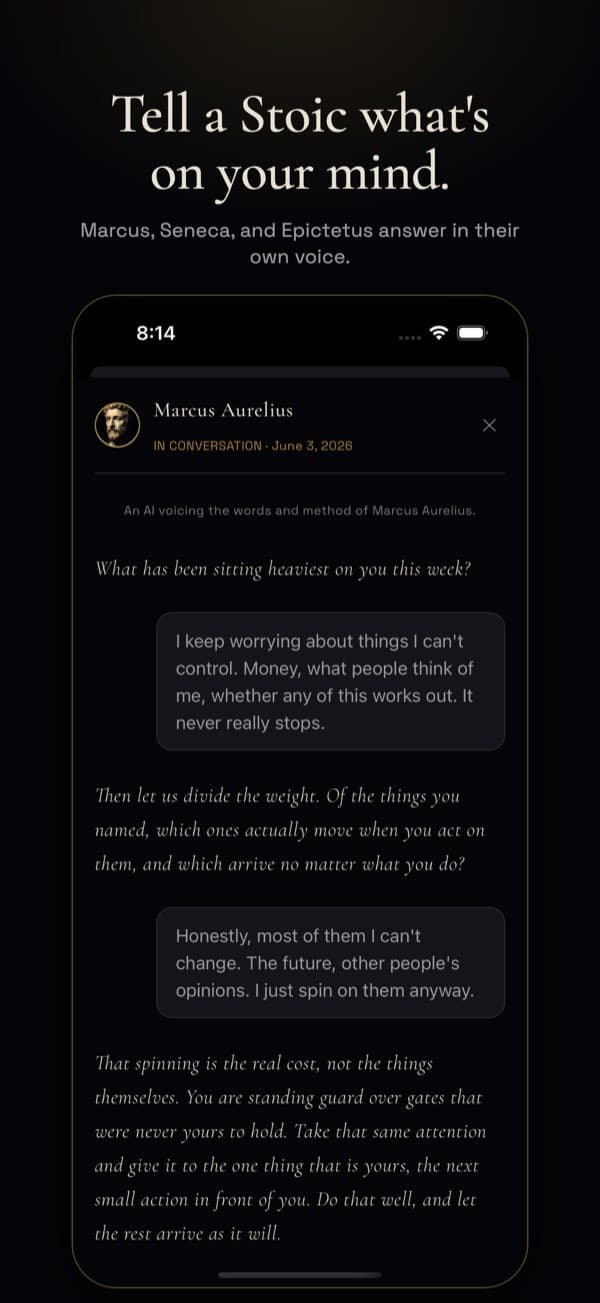
In the app, a mentor answers what you actually wrote, in his own cited words, and ends with a question back. Against the loop, it reads like this.
It's never the conversation. It's the fortieth replay of it.
Men are disturbed, not by things, but by the principles and notions which they form concerning things.
I've already lived tomorrow ten different ways, and it hasn't happened once.
Let not future things disturb thee, for thou wilt come to them, if it shall be necessary, having with thee the same reason which now thou usest for present things.
The rest of the answers live in the app.
Three voices in the app. One of them made the spiral his life's subject.

Imagined portrait, human-directed.
Seneca
For the spiral.
A statesman who watched his own mind invent disasters, and said so in writing. The voice for the loop itself.
Beasts avoid the dangers which they see, and when they have escaped them are free from care; but we men torment ourselves over that which is to come as well as over that which is past.
Letters to Lucilius 5.9 · tr. Richard Mott Gummere

Imagined portrait, human-directed.
Epictetus
For what you control.
Born a slave, exiled, unbothered. He drew the line between what is yours and what never was. The voice for when you're gripping things that were never in your hands.
Some things are in our control and others not.
Enchiridion 1.1 · tr. Elizabeth Carter

Imagined portrait, human-directed.
Marcus Aurelius
For perspective.
An emperor who wrote to himself at night, for no audience. The voice for when everything feels too large.
Nowhere either with more quiet or more freedom from trouble does a man retire than into his own soul.
Meditations 4.3 · tr. George Long
No true likeness of these men survives. Our portraits are imagined, made by human direction and human hands.
The practice, on a bad night
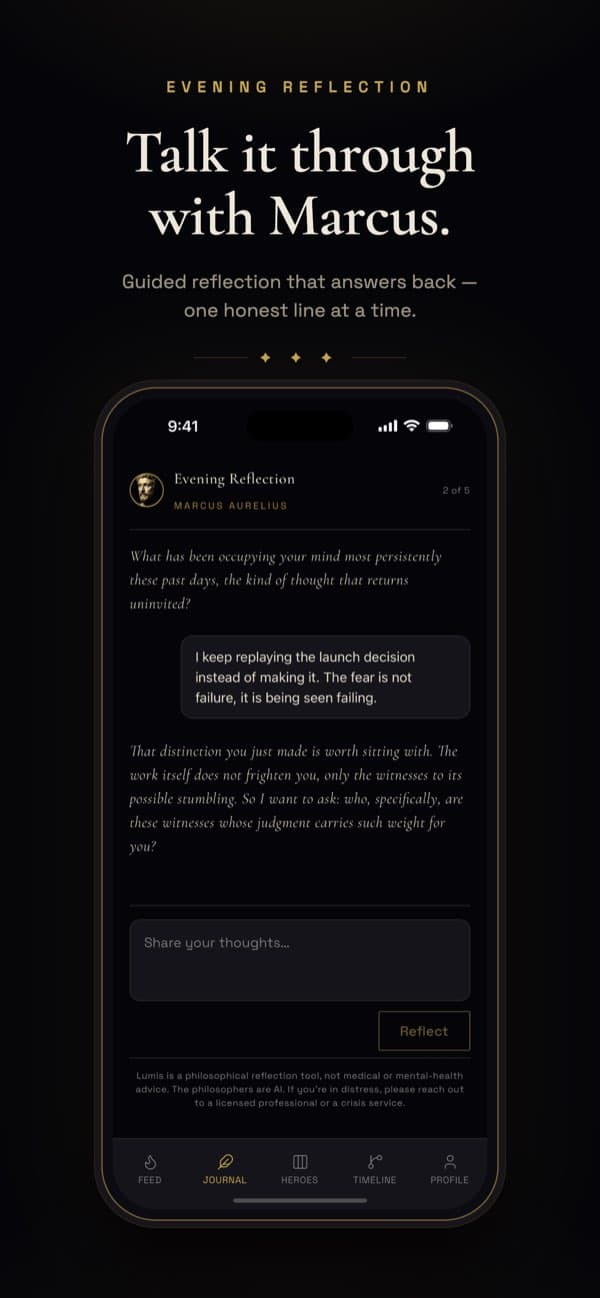
Write.
Open the app and a question is already waiting. Not a gratitude list. You write the actual replay, the actual worry, as it is, unpresentable. On the page, a thought can be examined rather than obeyed.
Counsel.
Your mentor answers what you wrote, not a template of it: a cited passage, and a question back. He asks; you reason. Nothing is diagnosed, because nothing here is being treated.
Act.
The entry closes with the judgment named and one small thing chosen for tomorrow. The thought is on the page now. It can wait there until morning.
7-day free trial. $99.99/year after, only if you stay. Cancel anytime in your Apple subscription settings.
The rooms you'd actually use at 2am.
Journal
Guided entries that start with a question waiting. The spiral goes in as it is; it doesn't have to be presentable first.
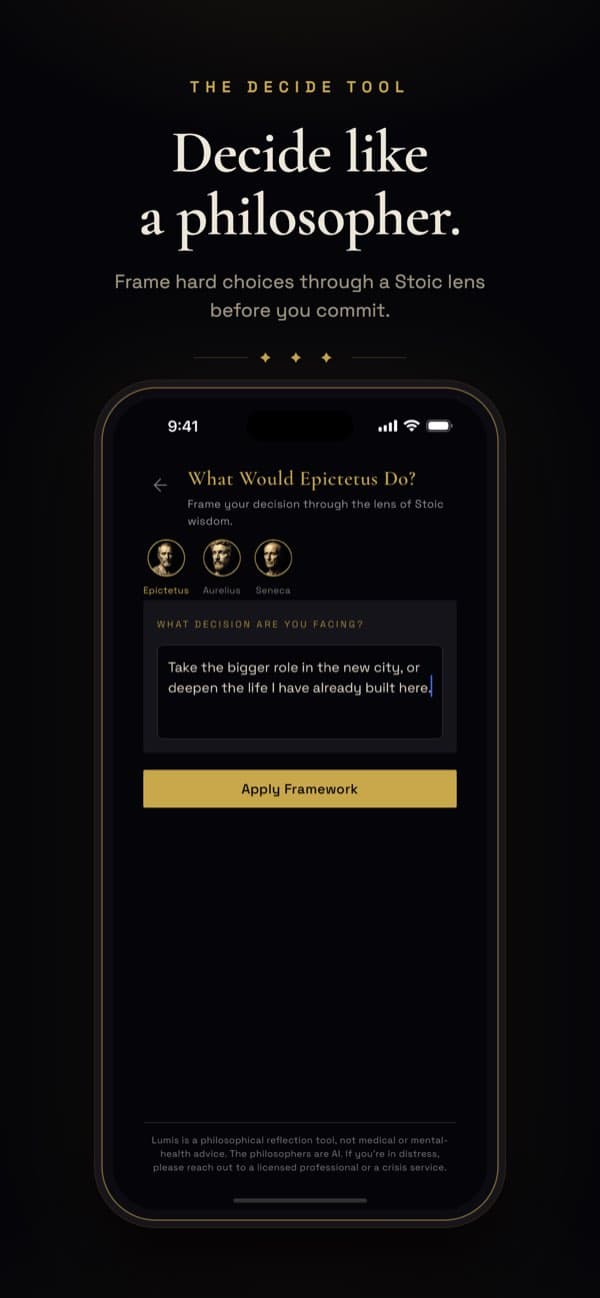
The Decide tool
For the decision you've been circling for weeks. Name the choice, weigh what's actually in your control, come out with a position you can defend to yourself.
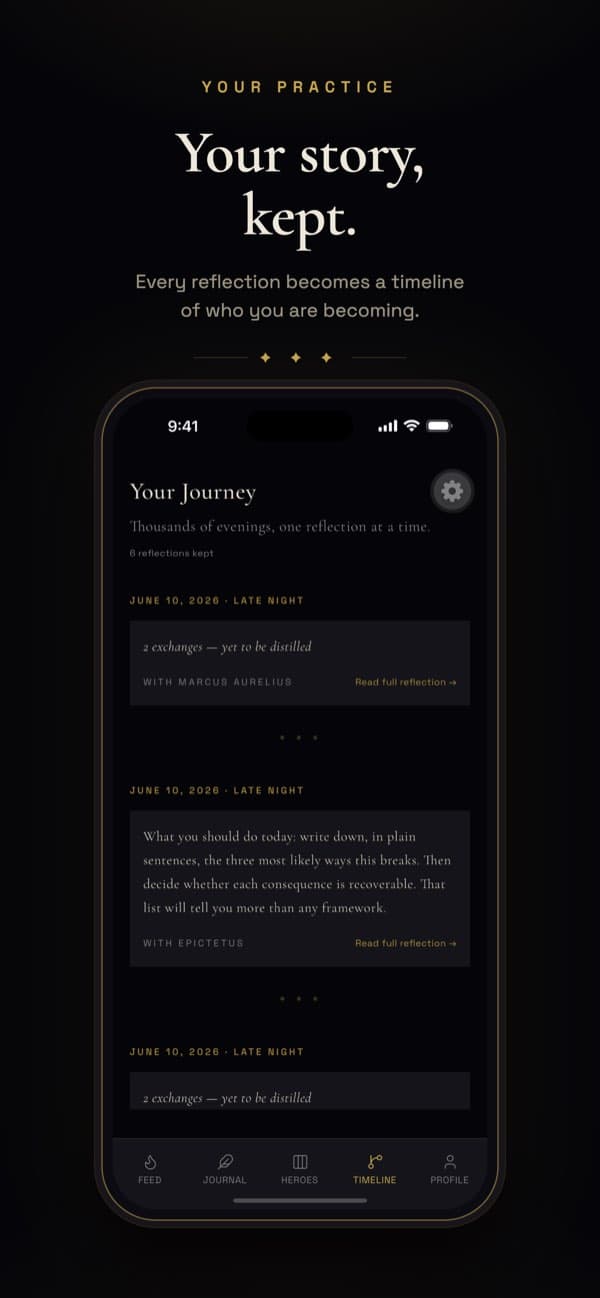
Timeline
Your entries, dated and kept. Scroll back a month and read which of the disasters actually arrived.
Who sees any of this
- 1.No mentor reads an entry until you grant that in the app. You can revoke it in the app. Revoked means they stop reading.
- 2.Your entries never train AI. Not by us; and Anthropic's commercial API terms prohibit training on our data.
- 3.Deletion is yours, in the app. Account, entries, conversations: gone from inside the app, no email, no support ticket.
The full block is on the front page, and the long version is at /privacy. They all say the same things. /privacy.
Questions worth asking first
Is this therapy?
No. Lumis is a practice, not treatment. Stoic journaling is a way to examine your own judgments; it doesn't diagnose anything, and it doesn't replace a therapist. Plenty of people keep both. If tonight is a crisis, use the resources near the top of this page, not an app.
Will this actually help?
It's a practice, not a pill, so here is exactly what happens: you write the thought down, a mentor answers it with a cited passage, and a question comes back to you. The Stoics kept this practice for two thousand years because a thought that has been examined behaves differently the next time it arrives. The first entry takes about two minutes. You'll know within a week of evenings whether it's yours.
Do I need to know anything about Stoicism?
No. This page can be the first time you've heard the word. The mentors meet you where you are, and nothing is assigned. If you get curious later, every quotation is cited to book and section, so the sources are one search away.
Who reads what I write?
By default, no mentor reads anything. Mentor access is a consent you grant in the app and can revoke in the app. When a mentor answers, your words are processed by Anthropic to generate the response, under commercial terms that prohibit training on them. You can delete your account and every entry from inside the app.
What does it cost?
$9.99 a month or $99.99 a year, each after a 7-day free trial; or $199.99 once for lifetime access. What you see is what you’re billed.
How do I start?
Download it, light the candle, and take the 7-day free trial. The first entry takes about two minutes.
If you want proof before you hand over an email: there's a live demo on the front page. Ask Marcus what's looping. No account needed.
The loop will be back tonight. That was never in question. The question is what meets it. Lumis won't promise you fewer thoughts; it gives the thought a place to land, a voice that has read the worst of human nights, and one question that turns the replay into an examination. You've already spent longer on one replay than the first entry takes.
The door is open.
7-day free trial. $99.99/year after, only if you stay. Cancel anytime in your Apple subscription settings.