A journal that answers back.
Guided Stoic journaling. You write; Marcus Aurelius answers what you actually wrote, in his own cited words, and asks a question back. Never a blank page.
Built on Meditations, Letters to Lucilius, the Discourses, the Enchiridion, and On Anger. Every quotation cited to book and section.

7-day free trial. $99.99/year after, only if you stay. Cancel anytime in your Apple subscription settings.
Built on Meditations, Letters to Lucilius, the Discourses, the Enchiridion, and On Anger.
Every quotation cited to book and section.
Reading your entries is a consent you grant in the app, and revoke in the app.
Conversations processed by Anthropic, under commercial terms that prohibit training on your words.
If you've kept a journal before, some of these are yours.
- Another blank page, and no idea where to start.
- I went back to paper. Paper can't leak.
- Ten years of entries, and the app changed underneath me.
- My most private thoughts are nobody’s training data.
The first one is about starting. The other three are about trust. Both get answered below, in sentences you can check.
Journaling did not begin with an app.
When the lamp is taken out of my sight, and my wife, who knows my habit, has ceased to talk, I pass the whole day in review before myself, and repeat all that I have said and done: I conceal nothing from myself, and omit nothing.
Seneca, describing his own evening pages, two thousand years before the first journaling app.
The oldest journaling testimony on record is a Stoic examining his day in writing. Lumis is that same practice, guided: a question waiting when you open the page, and a mentor who answers what you wrote.
What an entry looks like here
Write.
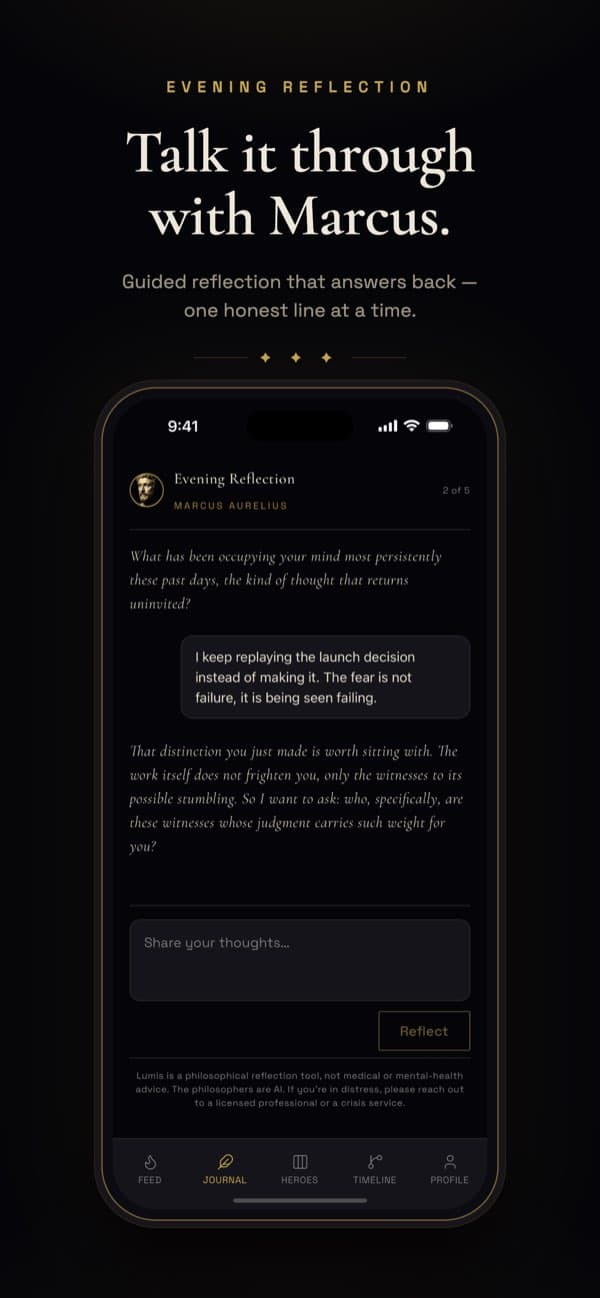
You never open to a blank page. A question is already waiting, in the lineage of the evening review the Stoics kept: Where did I go wrong? What did I do? What duty was left undone? (The Pythagorean verses Epictetus taught his students. Discourses, 3.10.) You write what's actually there.
Counsel.
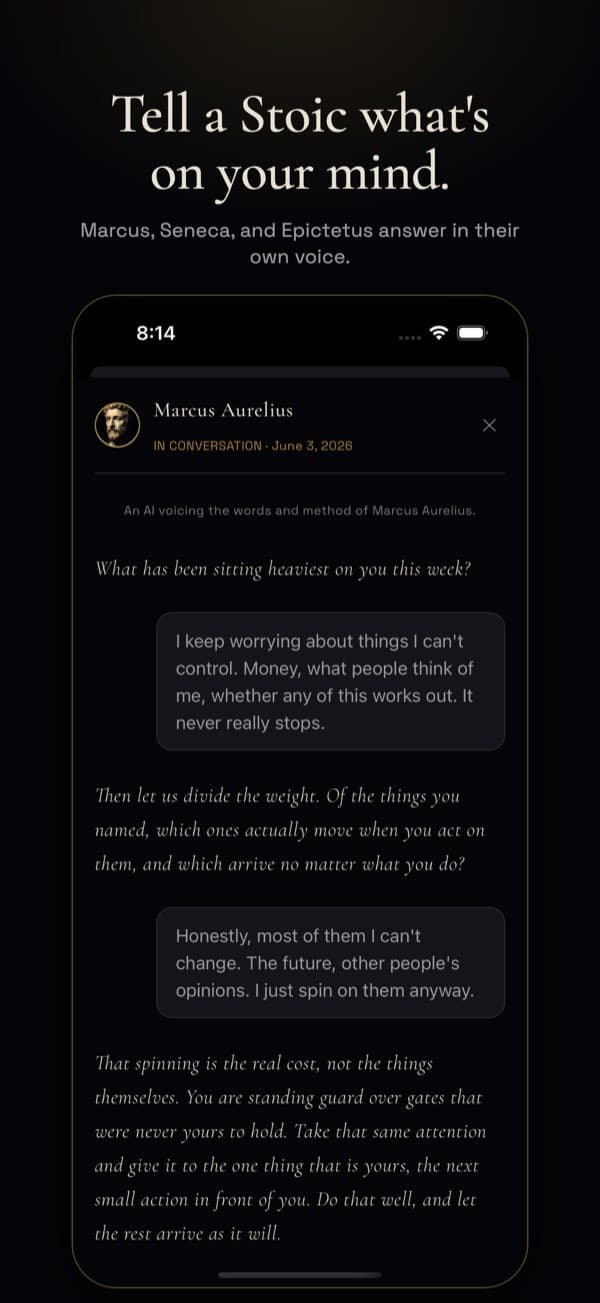
Your mentor answers what you actually wrote, not a template of it. The response draws on his own works, cited to book and section, and ends with a question back. He asks; you reason.
Act.
The entry closes where tomorrow starts: a judgment examined, a practice named, one thing worth carrying off the page.
7-day free trial. $99.99/year after, only if you stay. Cancel anytime in your Apple subscription settings.
The rooms a journaler lives in.
Journal
Guided entries that start with a question. Never a blank page.
Heroes
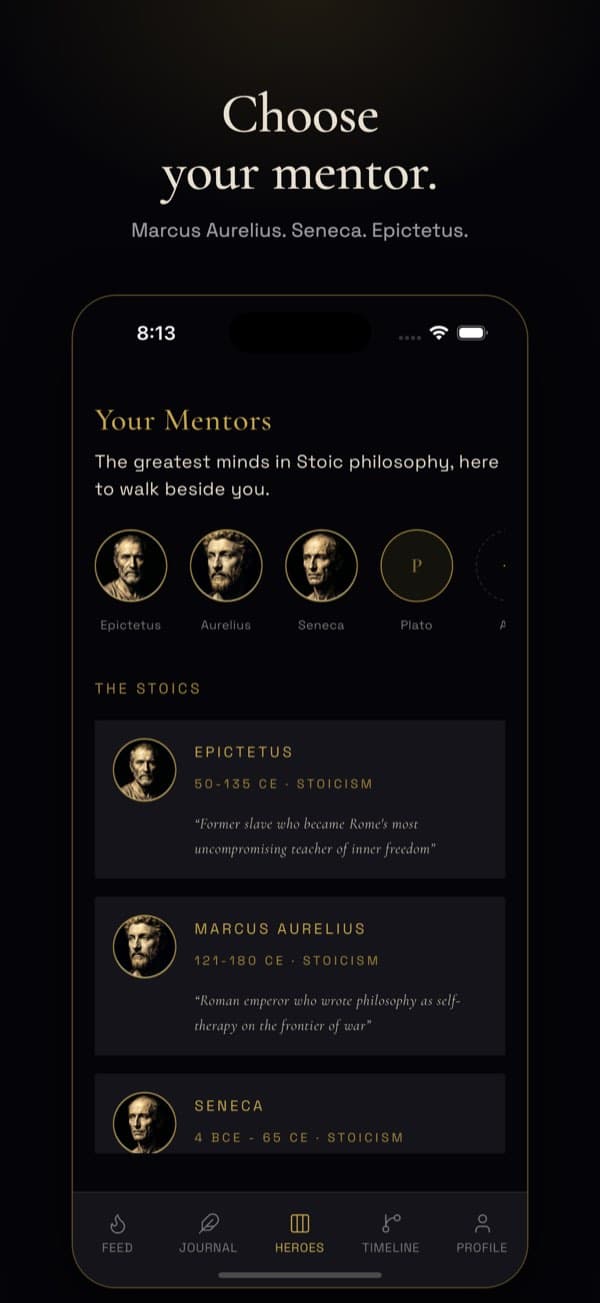
The mentors. Read them, then write to them. They answer what you actually wrote.
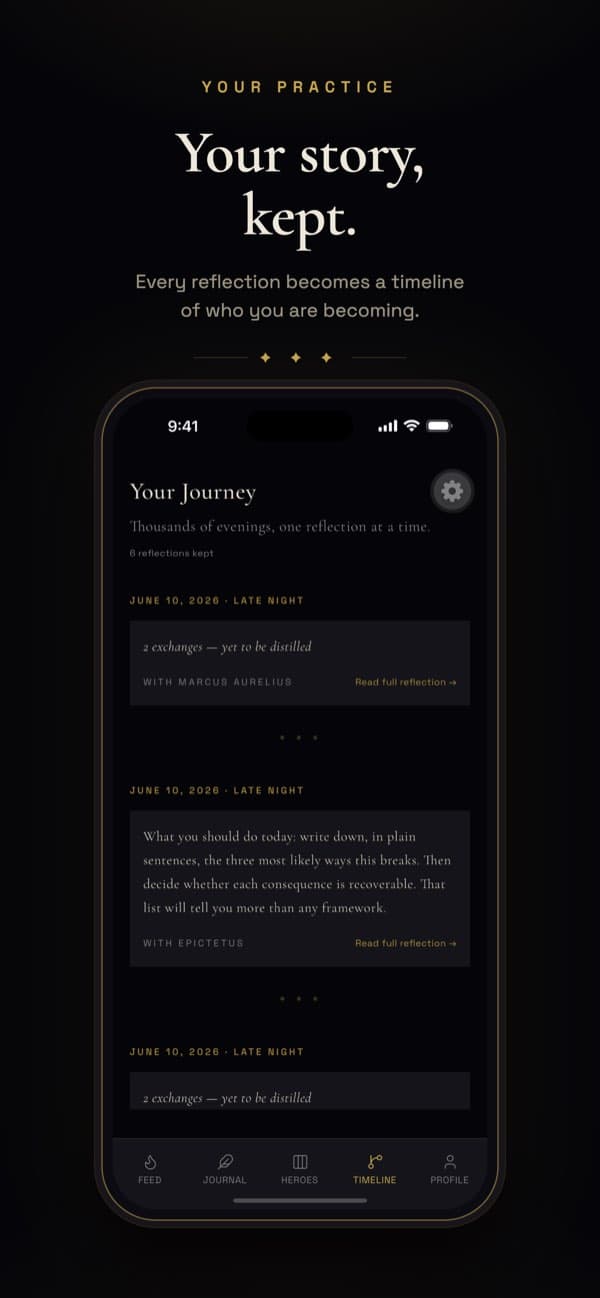
Timeline
Your entries, accruing into something you can look back through. Your own Meditations, in your own words.
The Decide tool
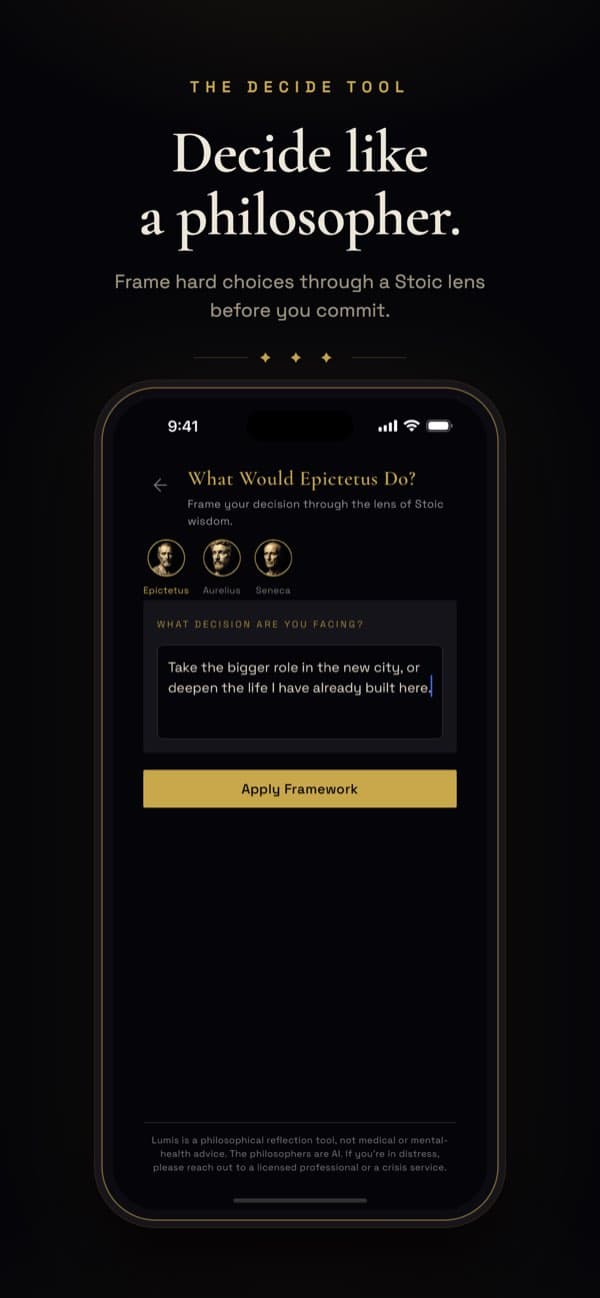
For the decisions your entries keep circling. Name the choice, weigh what's in your control, come out with a position you can defend to yourself.
What happens to your entries
A journal is the most private thing a person writes. Here is the whole arrangement, in checkable sentences.
- 1.Nothing is read by a mentor until you say so. Mentor access to your entries is a consent you grant in the app, and revoke in the app, any time. Revoked means they stop reading.
- 2.Your entries never train AI. Not by us; and Anthropic's commercial API terms prohibit training on our data.
- 3.The counsel is generated by Anthropic's Claude, and it is labeled as AI wherever it speaks.
- 4.Marcus remembers what you wrote yesterday, and here is exactly what that means: so counsel can follow your thread, your recent conversations are sent to Anthropic as context when a mentor answers, under the same no-training terms. Revoke consent and it stops.
- 5.Deletion is yours, in the app. Account, entries, conversations: deleted from inside the app, no email, no support ticket.
This page keeps its own ledger honest too. We use PostHog analytics to see which sections earn attention. If you join the list, your email is stored in Supabase and used for Lumis and nothing else.
The long version is at /privacy. It says the same things. /privacy.
Questions worth asking first
Who reads what I write?
By default, no mentor reads anything. Mentor access is a consent you grant in the app and can revoke in the app. When a mentor answers, your words are processed by Anthropic to generate the response, under commercial terms that prohibit training on them. You can delete your account and every entry from inside the app.
What does the AI actually do?
It doesn't write your journal, and it doesn't think for you. You write; the mentor responds to what you actually wrote, with counsel drawn from his own works, cited, and usually a question back. He asks; you reason. Everything AI-composed is labeled as AI.
I journal on paper. Why would I use an app?
Keep the paper journal; nothing here argues with it. What Lumis adds is the answer: a mentor who responds to what you wrote with a cited passage and a question back, and entries that accrue into a timeline you can look back through. What an app has to earn first is trust with the entries themselves. That is what the consent switch, in-app deletion, and no-training terms above are for.
Do I need to know anything about Stoicism?
No. If you've never read a page of Marcus Aurelius, the mentors meet you where you are. If you've read all of it, every quotation is cited to book and section, so you can check us.
What does it cost?
$9.99 a month or $99.99 a year, each after a 7-day free trial; or $199.99 once for lifetime access. What you see is what you’re billed.
Can I cancel anytime?
Yes. The subscription runs through Apple. Cancel in your Apple subscription settings anytime, including during the trial, and you won’t be billed.
How do I start?
Download it, light the candle, and take the 7-day free trial. The first entry takes about two minutes.
A journal only works if you can be honest in it, and honesty needs two things: somewhere to start, and certainty about where your words go. The first is a question, already waiting on the page. The second is a consent switch, a delete button, and terms that prohibit training. The rest is the oldest practice there is: the day, examined in writing.
The door is open.
7-day free trial. $99.99/year after, only if you stay. Cancel anytime in your Apple subscription settings.